

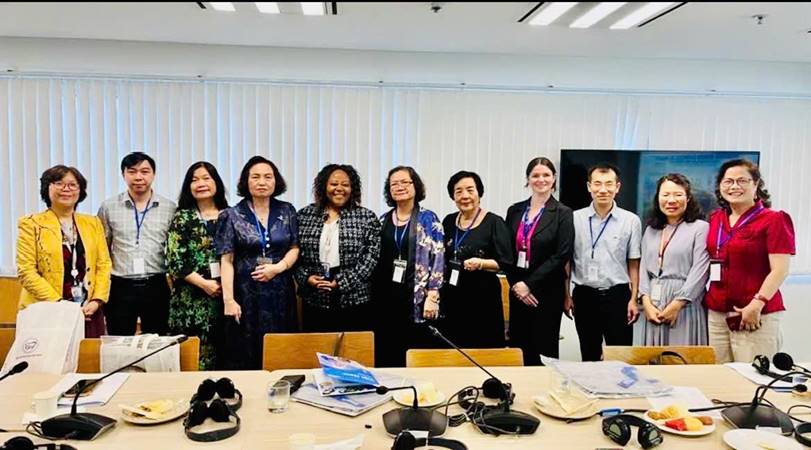
The meeting was not only a professional exchange but also reflected UN Women’s long-term orientation in promoting leadership, innovation, and economic empowerment for women. The focus of this strategy is to enhance women’s participation in science, technology, innovation, and entrepreneurship – pillars shaping the future economy.
In the context of Vietnam’s accelerated green transformation, digital transformation, and private sector development programs, female scientists are considered a valuable national asset. With their knowledge, research, and creativity, they can contribute significantly to economic growth and social development if placed in a favorable environment.
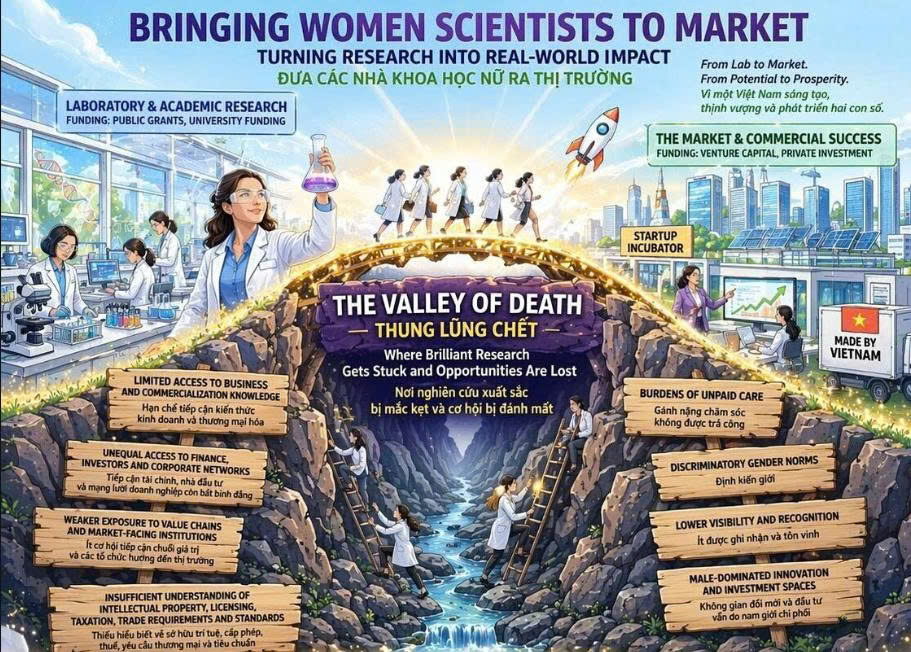
However, reality shows that the path from the laboratory to the market for female scientists remains fraught with challenges. One of the biggest challenges mentioned is the “valley of death,” a stage where research results are not yet commercially viable but also no longer receive support from their original funding sources. This bottleneck causes many valuable scientific ideas to get “stuck,” unable to be transformed into concrete products or services.
The barriers faced by female scientists are not limited to financial aspects. Limited access to investment capital, a lack of investor networks, and gaps in intellectual property support, business development services, and expert mentoring further complicate the commercialization process.
Experts at the meeting argued that to overcome these obstacles, an ecosystem approach is needed—not just individual or project support, but the creation of a synchronized structure connecting policies, institutions, and the market. In this, the roles of regulatory agencies, international organizations, businesses, and investment funds need to be closely coordinated to create a favorable environment for the development of female scientists.
Notably, Vietnam has yet to develop a complete ecosystem specifically designed to support the commercialization process for female scientists. This gap highlights the urgent need to learn from international experiences while simultaneously developing models suitable for domestic conditions.
Based on this, UN Women and the Vietnam Women Intellectuals Association plan to organize an international workshop in June 2026. This event aims to connect domestic and international experts, share successful models in building an ecosystem supporting women scientists, and discuss opportunities, challenges, and international practices applicable in Vietnam.
Beyond academic exchange, the workshop is expected to contribute to shaping strategic directions, thereby promoting the development of a substantive and effective ecosystem. This is considered a necessary step to bridge the gap between research and the market, enabling women scientists to not only create knowledge but also become important agents in the innovation economy.
In the long term, building a comprehensive support ecosystem not only promotes gender equality but also acts as a lever for sustainable growth. When scientific ideas are transformed into economic value, and when women can participate more deeply in this value chain, the economy will gain further impetus from resources that have long been underutilized.
Khanh Van. COSTAS, VAFIW
