

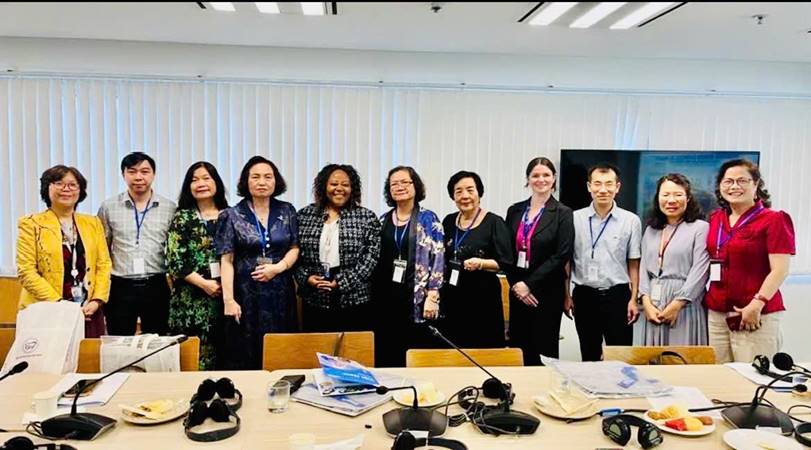
The meeting was not only a professional exchange but also reflected UN Women’s long-term orientation in promoting leadership, innovation, and economic empowerment for women. The focus of this strategy is to enhance women’s participation in science, technology, innovation, and entrepreneurship – pillars shaping the future economy.
In the context of Vietnam’s accelerated green transformation, digital transformation, and private sector development programs, female scientists are considered a valuable national asset. With their knowledge, research, and creativity, they can contribute significantly to economic growth and social development if placed in a favorable environment.
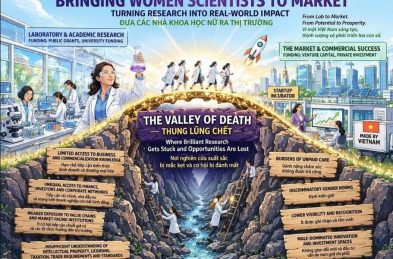
However, reality shows that the path from the laboratory to the market for female scientists remains fraught with challenges. One of the biggest challenges mentioned is the “valley of death,” a stage where research results are not yet commercially viable but also no longer receive support from their original funding sources. This bottleneck causes many valuable scientific ideas to get “stuck,” unable to be transformed into concrete products or services.
The barriers faced by female scientists are not limited to financial aspects. Limited access to investment capital, a lack of investor networks, and gaps in intellectual property support, business development services, and expert mentoring further complicate the commercialization process.
Experts at the meeting argued that to overcome these obstacles, an ecosystem approach is needed—not just individual or project support, but the creation of a synchronized structure connecting policies, institutions, and the market. In this, the roles of regulatory agencies, international organizations, businesses, and investment funds need to be closely coordinated to create a favorable environment for the development of female scientists.
Notably, Vietnam has yet to develop a complete ecosystem specifically designed to support the commercialization process for female scientists. This gap highlights the urgent need to learn from international experiences while simultaneously developing models suitable for domestic conditions.
Based on this, UN Women and the Vietnam Women Intellectuals Association plan to organize an international workshop in June 2026. This event aims to connect domestic and international experts, share successful models in building an ecosystem supporting women scientists, and discuss opportunities, challenges, and international practices applicable in Vietnam.
Beyond academic exchange, the workshop is expected to contribute to shaping strategic directions, thereby promoting the development of a substantive and effective ecosystem. This is considered a necessary step to bridge the gap between research and the market, enabling women scientists to not only create knowledge but also become important agents in the innovation economy.
In the long term, building a comprehensive support ecosystem not only promotes gender equality but also acts as a lever for sustainable growth. When scientific ideas are transformed into economic value, and when women can participate more deeply in this value chain, the economy will gain further impetus from resources that have long been underutilized.
Khanh Van. COSTAS, VAFIW


On November 15, in Hanoi, the National Innovation Center (NIC), the Ministry of Planning and Investment, in collaboration with Google, organized the Workshop “Creating the AI Future for Vietnam” to exploit the potential of AI and discuss policies and mechanisms for AI development in Vietnam. Deputy Minister of Planning and Investment Do Thanh Trung attended and delivered the opening speech at the Workshop.
Speaking at the workshop, Deputy Minister of Planning and Investment Do Thanh Trung said that, in its role as a general advisory body on socio-economic development strategies, the Ministry has advised and submitted to the Prime Minister for approval the Program “Developing human resources for the semiconductor industry to 2030, with a vision to 2050” in Decision No. 1017/QD-TTg, which proposes the goal that by 2030, Vietnam will have at least 5,000 engineers or higher with in-depth expertise in artificial intelligence (AI) to serve the semiconductor industry. At the same time, the Ministry of Planning and Investment has assigned the National Innovation Center to coordinate with domestic and international partners and experts to research and build an AI Training, Research and Application Center to serve AI business incubation, support AI research, application and in-depth training on AI with the goal of training 7,000 AI experts according to international standards by 2030 and incubating about 500 AI startups.
These are very proactive steps of the Ministry to realize the goal of Vietnam soon becoming a center for innovation, developing solutions and applying artificial intelligence in the ASEAN region and the world.
“With the desire to promote the strong development of the Vietnamese AI community, making Vietnam one of the leading AI research and application centers in the region, the Ministry of Planning and Investment will always support and accompany and continue to advise on mechanisms and policies to develop AI technology,” Deputy Minister Do Thanh Trung affirmed.
At the Workshop, Google representative introduced the content of the Economic Impact Report: Promoting digital growth in Vietnam with Google.
According to Google research, the potential from AI in Vietnam is huge, with estimated economic benefits of up to VND1,890 trillion (US$79.3 billion) for businesses by 2030, if AI tools are widely applied. This figure is equivalent to nearly 12% of Vietnam’s GDP by 2030.
To fully exploit the potential of AI, according to Google’s AI Opportunity Agenda for Vietnam, Vietnam needs to strengthen its technical infrastructure for AI-based innovation, build an AI-ready workforce, and increase access to AI across the economy. Google’s report also provides an in-depth analysis of strategies to bridge the digital and AI knowledge gap, helping the Vietnamese workforce make effective use of AI and drive economic growth.
Accordingly, to fully exploit the transformational potential of AI, Vietnam needs to focus on retaining and developing domestic talent by expanding access to digital education and accelerating the implementation of corporate training programs. To maximize the economic benefits of AI, Vietnam needs to prioritize the development of a digital workforce. Closing the digital skills gap through specialized training and technology application will open up great economic potential for the country.
In addition, the report quantifies Google’s current contribution to supporting businesses, households, and the workforce in Vietnam through Google’s diverse AI-integrated products and services such as: Google Search, Google Ads, Google AdSense, Google Play and YouTube; Google Cloud, Google Workspace…
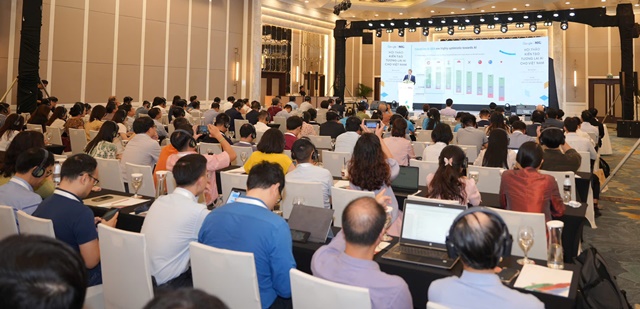 |
| Mr. Andrew Ure, Senior Director of Government Relations and Public Policy of Google Southeast Asia of Google Corporation, speaking at the Workshop (Photo: HNV) |
“With a young, tech-savvy population and a dynamic digital landscape, Vietnam is well-positioned to tap into the opportunities presented by AI,” said Andrew Ure, Senior Director of Government Relations and Public Policy at Google Southeast Asia. “We are therefore delighted to partner with NIC to introduce the first AI Policy & Skilling Lab to Vietnam. We look forward to working with the Vietnamese government, ministries and research institutions to build an AI-powered future that benefits everyone.”
Also at the Workshop, experts from state management agencies, research institutions, and business representatives discussed and proposed specific solutions and initiatives to promote proactive investment in AI research and development; build a high-quality AI workforce; develop an AI innovation ecosystem to create a favorable environment for creative AI ideas to be nurtured and developed. In addition, a topic of interest discussed at the Workshop was about synchronous solutions to build an AI legal framework to ensure that AI is developed and applied safely, responsibly, and in compliance with ethical values.
On this occasion, Google Corporation, other corporations, technology enterprises, universities, research institutes, experts and scientists have also paid attention to building visions, goals and action plans for major tasks related to AI including: actively and proactively investing in AI research and development; building a high-quality AI workforce; developing an AI innovation ecosystem to create a favorable environment for creative AI ideas to be nurtured and developed; jointly participating in building an AI legal framework to ensure that AI is developed and applied safely, responsibly and in compliance with ethical values…
| The workshop “Creating the AI future for Vietnam” is one of the practical and meaningful activities to proactively implement Decision No. 127/QD-TTg of the Prime Minister on the National Strategy on Research, Development and Application of Artificial Intelligence to 2030. On the part of the Ministry of Planning and Investment, as a general advisory body on socio-economic development strategies, the Ministry has advised and submitted to the Prime Minister the “Project on Human Resource Development for the Semiconductor Industry to 2030, with a vision to 2050”. At the same time, the Ministry of Planning and Investment has assigned the National Innovation Center to coordinate with domestic and international partners and experts to research and build an AI Training, Research and Application Center to serve AI business incubation, support AI research, application and in-depth training on AI. These are very proactive steps of the Ministry to realize the goal of Vietnam soon becoming a center for innovation, developing solutions and applying artificial intelligence in the ASEAN region and the world. |

On the afternoon of October 31, the Association of Women Intellectuals of the Ministry of Science and Technology (MOST) in coordination with the Ministry’s Committee for the Advancement of Women organized a seminar on “The journey of self-understanding to enhance the inner strength of female cadres”.
The event took place in an exciting atmosphere with the participation of representatives of the Vietnam Association of Information Technology and a large number of members of the Ministry of Science and Technology’s Association of Information Technology.
 |
| Overview of the Seminar “The journey of self-understanding to enhance the inner strength of female cadres” |
Speaking at the opening of the Seminar, Ms. Pham Thi Van Anh, Director of the Department of Organization and Personnel, Deputy Head of the Department for the Advancement of Women, Deputy Head of the Women’s Union of the Ministry of Science and Technology, emphasized the increasingly important role of female cadres in the science and technology sector. She said that the Ministry’s leaders always pay attention to and focus on developing this team, especially in planning, training and fostering. The Seminar is expected to be an opportunity for female cadres to improve their capacity, expand their knowledge, develop their skills and increase their confidence.
 |
| Dr. Pham Thi My, Permanent Vice President of Vietnam ICT Association, spoke at the seminar. |
Dr. Pham Thi My, Permanent Vice President of the Vietnam Intellectuals Association, affirmed that the Seminar is a practical activity in implementing Decree 45/NQ-TW on building a strong and comprehensive intellectual team. She also shared about Vietnam’s remarkable achievements in promoting gender equality, and affirmed that the Government will create all favorable conditions for female intellectuals to maximize their capacity.
“ During the meeting with female intellectuals with the Prime Minister on the occasion of the Asia-Pacific Network of Women Scientists and Engineers Conference held in Hanoi from October 4-5, 2024, the Prime Minister affirmed that the Government will create all favorable conditions for intellectuals, including female intellectuals, to maximize their capacity and enthusiasm through continuing to improve policy mechanisms, strongly invest in science and technology research, prioritize financial resources, and focus on training high-quality human resources…” – Dr. Pham Thi My said.
The Standing Vice President of the Vietnam Association of Information Technology said that the seminar will help members of the Ministry of Science and Technology’s Association of Information Technology access scientific tools to understand themselves, have a correct perspective on themselves, and be confident in their activities.
The highlight of the seminar was the sharing of MSc. Nikole Vu Huong Giang, Director of Me&We Company, about tools to explore the subconscious power and hidden potential of each person.
MSc. Nikole Vu Huong Giang shares methods to help female cadres identify their strengths, weaknesses, core values and potentials. From there, they can build confidence, develop leadership skills, manage emotions and create positive relationships.
 |
| MSc. Nikole Vu Huong Giang, Director of Me&We Company, shares about tools to explore the subconscious power and hidden potential of each person. |
Through diverse activities such as experience sharing, interactive games and group practice, the Seminar created an open space for female cadres to share, listen and connect with each other.
Not only does she help women understand themselves, Ms. Nikole Vu Huong Giang also equips female cadres with the knowledge and skills necessary to develop their careers and lives: methods to control emotions immediately, set goals consistent with their value system, make decisions in all situations, magic of words…
 |
| MSc. Le Thi Khanh Van, Executive Committee Member of Vietnam Association of Information Technology, Head of the Association of Information Technology of the Ministry of Science and Technology, delivered a speech at the Closing Ceremony. |
In her closing remarks at the Seminar, Ms. Le Thi Khanh Van, Head of the NTT Association of the Ministry of Science and Technology, affirmed that the Seminar was an opportunity for female cadres to connect, share experiences, and support each other to overcome challenges. In addition, the representative of the Executive Committee of the Association will also promote practical and meaningful activities, creating conditions for members to exchange, learn and develop.
A good news shared by MSc. Khanh Van is that the research topic on female scientists has received the attention of the Prime Minister. The Prime Minister has assigned the task to the Vietnam Women’s Union and the Ministry of Finance to consider and propose the establishment of a Fund for female scientists and appropriate policy mechanisms. This is a positive signal, affirming the attention of the Party and State to the development of female intellectuals.
 |
| On the sidelines of the Seminar, experts from V-Green Group Corporation sponsored health index measurements and Kombucha products and health powders for delegates attending the Seminar. |
 |
| Delegates attending the Seminar took souvenir photos |

 |
| Delegates take souvenir photos at the seminar |
Attending the discussion were leaders of the Vietnam Association of Intellectual Women and all members of the Association of Intellectual Women of the Ministry of Science and Technology. The speaker was Nicole Vu Huong Giang – who studied the NLP Master Trainer Program at NLP University in the US and was known as “the first Vietnamese matchmaker born in the 80s with an international matchmaking certificate” when she organized many training courses to “heal” all relationships in society, or in other words, to have the skills to understand one’s own value and handle well all situations that occur in life.
In her opening speech, Ms. Pham Thi Van Anh, Director of the Department of Organization and Personnel, Deputy Director of the Department for the Advancement of Women, Deputy Director of the Association of Women Intellectuals of the Ministry of Science and Technology, emphasized the important role of female cadres in the science and technology sector, the participation and contribution of female cadres are increasingly being affirmed in all fields. The leaders of the Ministry of Science and Technology always pay attention to and focus on developing female cadres, especially in planning, training and fostering… The seminar is an opportunity for female cadres to improve their capacity, expand their knowledge, develop their skills and increase their confidence in the context of the new era.
 |
| Dr. Journalist Pham Thi My – Permanent Vice President of the Vietnam Association of Women Intellectuals speaks |
Dr. Journalist Pham Thi My – Permanent Vice President of the Vietnam Association of Women Intellectuals affirmed: The topic of the discussion is very meaningful because it is an activity to practically implement Decree 45/NQ-TW dated November 24, 2023 of the 8th Conference of the 13th Party Central Committee on building a strong and comprehensive intellectual team, which is an investment in building and nurturing the national spirit. The Party and the State also highly value the intellectual team, including female intellectuals, and create many favorable conditions to implement gender equality, helping them develop their capacity. “However, the most important factor is still self-capacity. I congratulate the Association of Women Intellectuals of the Ministry of Science and Technology for choosing a very useful topic, helping women access scientific tools to understand themselves, have a correct view of themselves, be confident and always need advice, exchange and cooperation in the process of their activities” – Dr. Pham Thi My emphasized.

Speaker Nicole Vu Huong Giang’s presentation had a strong attraction to the audience because of the knowledge and tools for understanding oneself through two journeys that she provided very vividly, specifically and practically. These are: The potential of the brain, Exploiting the power of the subconscious, Understanding one’s own personality and that of others, Approaching motivation, How to create self-power, Balancing emotions, Connection methods, The art of words, Controlling emotions, Expanding perspectives, Making decisions, The secret of the law of attraction, Unifying goals with the value system…
In particular, Ms. Huong Giang also introduced how to test yourself on the journey of understanding yourself, to adjust appropriately and effectively.
The exchange between the speaker and the participants of the seminar added a lot of useful knowledge around the topic of Understanding yourself to improve your inner strength.
 |
| Overview of the seminar |
In addition to understanding themselves intellectually, emotionally, spiritually, etc., the seminar participants also understood themselves physically through measuring health indicators with advanced measuring machines and receiving advice from doctors on body care.
At the end of the discussion, Head of the Association of Women Intellectuals of the Ministry of Science and Technology Le Thi Khanh Van, Director of COSTAS under the Vietnam Association of Women Intellectuals, thanked speaker Nicole Vu Huong Giang for a very useful and interesting presentation; thanked V-Green Group Joint Stock Company for sponsoring drinks produced by the company itself, equipment and experts in measuring health indicators, and consulting on health care for women. “Hopefully, after this discussion and through “self-examination” using the test tool provided by Me&We, all of us women will become “directors of the movie of our lives” as Ms. Huong Giang said, and will fulfill both the roles of family and country” – concluded MSc. Khanh Van.
 |
Source: Nguyen Thi Tram TC SK&MT

The exhibition “Intellectual property and innovation and creativity of Vietnamese female intellectuals” has nearly 30 booths of 38 units representing institutes, academies, universities and participating businesses.
VNA – On the occasion of the World Intellectual Property Day (April 26), on the morning of April 21, in Hanoi, the National Office of Intellectual Property (Ministry of Science and Technology) in collaboration with the Vietnam Association of Intellectual Women and the National Agency for Science and Technology Information organized the Exhibition “Intellectual property and innovation and creativity of Vietnamese intellectual women” to contribute to recognizing and honoring the intellectual work results and great creative achievements of Vietnamese intellectual women.
The exhibition has nearly 30 booths of 38 units representing institutes, academies, universities, and participating businesses, with nearly 200 intellectual properties and innovation results mainly in the fields that are the strengths of female intellectuals such as: Medicine – pharmacy, biotechnology, automation, information technology, materials – chemicals, food processing, agriculture, environmental pollution treatment…
This is one of the activities of the task “Raising awareness and capacity to use intellectual property tools, innovation in scientific research and business production for the Vietnamese female intellectual community” under the Intellectual Property Development Program to 2030 with the aim of supporting female intellectuals to promote and introduce intellectual property and innovation results, and seek opportunities to apply and commercialize intellectual property.

Women all over the world have been playing a significant role in creating breakthrough scientific research results, establishing new creative trends, and contributing to the transformation of the world in a more positive direction. Through scientific research and innovation activities, women have been affirming their position and role. They deserve to be recognized and honored by society and the community. To achieve the goal of bringing our country out of underdevelopment and basically becoming a modern industrialized country requires promoting to the highest level all resources and intellectual potential of the nation, especially the creative capacity of the intellectual team, in which female intellectuals have been and are holding an important position.
Deputy Minister of Science and Technology Tran Van Tung said that in the rapid development of modern technology towards the Fourth Industrial Revolution, intellectuals become a particularly important resource, creating the strength of each country in the socio-economic development strategy.
Statistics from the National Agency for Science and Technology Information in 2019 show that the number of women participating in research accounts for 46% of the total research and development workforce. The Vietnamese female intellectual community is very diverse, including female scientists and businesswomen in all fields nationwide. Female intellectuals have contributed many valuable scientific works in theory and practical applications in many areas of social life; many research topics and scientific initiatives have benefited the country by billions of dong. Currently, female intellectuals still have a lot of intellectual property, scientific and technological research results of economic value, meeting practical needs, but have not been commercialized.
Deputy Minister Tran Van Tung added that, in addition to the successes, there are still many obstacles and difficulties that limit the position and role of female intellectuals. Therefore, supporting female scientists, promoting, introducing and implementing trade promotion activities, connecting them with businesses to exploit and develop the value of intellectual assets, promoting and enhancing the effectiveness of intellectual property rights enforcement is really necessary.
Within the framework of the Exhibition, there are a number of main activities such as: Displaying and introducing intellectual properties and innovation results, Science and Technology products, new protected varieties; Seminar “Some intellectual property issues to note in cooperation between Universities – Research Institutes – Enterprises”; Training “Intellectual property and skills in using intellectual property tools in production – business”; Seminar: “Female scientists introduce inventions and useful solutions that have been successfully commercialized, typical enterprises in using intellectual property tools successfully and effectively.”
In addition, the Organizing Committee will arrange a consulting area for science and technology information and intellectual property for businesses, scientists and interested parties. The exhibition will take place on April 21 and 22./.
Source: from website: vista.gov.vn of National Agency for Science and Technology Information
